Wednesday, September 1, 2010
FIPP2010


Wednesday, June 23, 2010
20th International Precious Stones Fair, Teófilo Otoni, Minas Gerais, Brazil, August 24-28, 2010

20th International Precious Stones Fair
22nd Open Precious Stones Fair
Locale: Clube Palmeiras, Teófilo Otoni, Minas Gerais, Brazil
"The largest international precious stones fair in Latin America"
20ª Feira Internacional de Pedras Preciosas, Teófilo Otoni, MG, 24-28 agosto 2010
20ª FEIRA INTERNACIONAL DE PEDRAS PRECIOSAS
22ª FEIRA LIVRE DE PEDRAS PRECIOSAS
Local: Clube Palmeiras, Teófilo Otoni, Minas Gerais, Brasil
"A MAIOR FEIRA INTERNACIONAL DE PEDRAS PRECIOSAS DA AMÉRICA LATINA"
Tuesday, May 25, 2010
Daniel Katz of Australia has something to add to the GAAJ story -- their side:
On Tue, May 25, 2010 at 11:28 AM, Daniel Katz
GAAJ-ZENHOKYO
Sirs,
Please explain :
http://mdn.mainichi.jp/mdnnews/news/...na014000c.html
" Major gem company manipulated color standards to overestimate diamond quality
A leading gemology company engaged in diamond grading had deliberately overestimated diamond qualities by manipulating color evaluation standards, it has been learned.
The Gemological Association of All Japan (GAAJ) had been using the manipulated color standards between late February in 2007 and late October in 2008, affecting some 338,000 diamonds that were evaluated during the period, industry insiders told the Mainichi."
I would appreciate your quick reply
Daniel F Katz
www.DiamondImports.com.au
The Response
Dear Mr. Daniel Katz,
Thank you for your inquiry.
We are attaching the letter we sent to all our customers as response to the newspaper article.
We hope it will answer any questions raised after reading the article.
Please feel free to contact us if you have any more questions.
Sincerely yours,
Nadia Goldstein
Executive secretary
Nadia Goldstein
Zenhokyo Israel
The Letter
17th May 2010
To our customers,
Our view of MAINICHI Newspapers reports
Gemmological Association of All Japan Co.Ltd.
President Natsuki TAKAHASHI
On 15th and 16th May 2010, MAINICHI Newspapers reported that GAAJ-ZENHOKYO laboratory engaged company-wide in “manipulating colour standards to overestimate diamond quality”.
This press report is definitely not based on true facts. However, I
personally, as well as the company “Gemmological Association of All Japan Co. Ltd” are sincerely sorry for any inconvenience and anxiety that were caused to our customers- inconvenience and anxiety which were certainly not of our doing.
GAAJ-ZENHOKYO laboratory hereby announces that there is nothing fraudulent in our diamond grading, as publicised in the newspaper, and we have been, as always,performing fair grading at our laboratory.
We are determined to clarify the facts of the matter and will devote all our efforts to do it.
In Japan, diamond grading is performed based on the standards employed by GIA, and diamonds are evaluated on the so-called “4Cs” – cut, colour, clarity and carat.
Colour grading is performed based on the system using the masterstones approved by JJA/AGL, which was created by reference to GIA masterstones and was implemented in September 1996.
The system aims to prevent variations in colour grading among the
AGL (Association of Gemmological Laboratories Japan) members by letting the
members possess and properly operate the colour-masterstones, which are approved by Japan Jewellery Association (JJA) and AGL after consultation between them.
Diamonds are graded by highly experienced and trained expert graders.
However, there are always border stones (i.e. stones that are situated between one grade and the next).
Clarity and colour evaluation especially, cannot be quantified or mechanically gauged,so the grading results largely depend on the experience and subjective judgment of the grader.
GAAJ-ZENHOKYO laboratory holds regular meetings to match up individual
evaluation basis to eliminate variation between graders and branches.
The “direction” as described in the news report was a memorandum record of one of such regular meetings.
As it is, we had been receiving several comments that our results on colour gradingwere too strict compared to other gemmological laboratories belonging to AGL, whichraised our graders concern.
After an annual checking up session for diamond grading held by AGL, it was learned that the grading of GAAJ-ZENHOKYO laboratory traditionally tended to downgrade diamond colour that sat very close to the borders.
Atone of our regular meetings as mentioned above, we discussed correction of this tendency.
We systematically researched the trend of GIA or AGL member laboratories
on colour grading, and kept matching up and exchanging information between our expert graders.
As a result, we reached the conclusion that our grading determination on
borders should be slightly corrected, as stated in the in-house document.
The content of the memorandum therefore was summarised for our graders to show the correction range for those graders who tended to downgrade, in order to improve the operation of the approved masterstones with the border stones.
It was definitely not instruction to uniformly upgrade stones by half to one grade.
That regular meeting was held to eliminate variation on diamond grading between GAAJ-ZENHOKYO laboratory and other AGL members, in conformity with the approved masterstone system, and to seek consistent and uniform grading results between our expert graders.
Never did we aim to give “loose” or “favourable” grading results for our own interest as described in the news report.
Again please accept our sincere apologies for any inconvenience caused as a result of the news report.
We reaffirm our resolute stance against the report that is in no way based on true facts.
Meanwhile, we are making extreme efforts to prove the report as false and to restore confidence in the industry.
Your understanding is most truly appreciated.
Saturday, May 22, 2010
Gemological Association of All Japan (GAAJ) appraisal company accused of overvaluing diamonds resigns from industry association
Gem appraisal company accused of overvaluing diamonds resigns from industry association

The Mainichi Daily News, May 23, 2010
A leading gem appraisal company that is accused of deliberately overestimating the color qualities of diamonds has given up its membership in the national gem industry association responsible for setting diamond grading standards.
The company, called the Gemological Association of All Japan (GAAJ), submitted a request for termination of its membership, which was accepted at an emergency board of directors' meeting on Friday of the industry association, called the Association of Gemological Laboratories Japan (AGL).
The reasons given for the termination included "creation and leaking of an internal document of dubious content," in reference to guidelines for artificially bumping up the "color" ranks of diamonds in an alleged bid to increase their price.
During questioning by AGL directors, the GAAJ admitted to creating the document, which advised "correcting" color values of diamonds a half to a full grade closer to "transparent" than they should have been based on standards set in part by the AGL.
The AGL has decided to offer free re-appraisals on request for diamonds the GAAJ appraised from February 2007 to October 2008. A diamond's accompanying appraisal certificate should show a date within that range to be eligible. The AGL has requested the unique serial numbers of the relevant appraisal certificates from the GAAJ.
Link: http://mdn.mainichi.jp/mdnnews/news/20100522p2a00m0na005000c.html
Gemological Association of All Japan intentionally and fraudulently manipulated diamond color grades to over-estimate quality
Major gem company (GAAJ) manipulated color standards to overestimate diamond quality

by The Mainichi Daily News, May 22, 2010
A leading gemology company engaged in diamond grading had deliberately overestimated diamond qualities by manipulating color evaluation standards, it has been learned.
The Gemological Association of All Japan (GAAJ) had been using the manipulated color standards between late February in 2007 and late October in 2008, affecting some 338,000 diamonds that were evaluated during the period, industry insiders told the Mainichi.
The Association of Gemological Laboratories Japan (AGL), which is responsible for the industry's uniform evaluation standards and to which GAAJ belongs, is poised to question GAAJ over the suspected manipulation at an early date.
The GAAJ, however, has refuted the allegations, saying, "We only rectified deviations of our in-house evaluation standards."
According to industry sources, the GAAJ discussed manipulating diamond color evaluation standards during a technical meeting at its Tokyo headquarters on Feb. 24, 2007. Two days later, the association's board officially decided to go ahead with the manipulation so that color evaluation of diamonds weighing 1-carat (0.2 grams) or over would be upgraded by a half to one grade compared to the industry's uniform standards, and that of diamonds weighing less than 1-carat would be upgraded by a half grade.
Following the decision, the association started overestimating diamonds at the Tokyo headquarters as well as its Osaka and Fukuoka branch offices.
In October 2008, a jewelry shop in Tokyo reported to AGL that the evaluation conducted by GAAJ's Fukuoka office was wrong, prompting AGL to re-evaluate the questionable diamonds. As a result, it turned out that GAAJ had overestimated diamond quality in terms of color.
GAAJ is one of the top three gemology companies in Japan that boast a combined 70 to 80 percent share of diamond evaluation in the domestic market. The evaluation certificates such companies issue are used to value diamonds retailed at major department stores and other outlets across the country.
If the color evaluation of a diamond is upgraded by one grade, the retail price can rise tens of thousands of yen to over 100,000 yen higher. As a result of the GAAJ's manipulation, retailers and consumers were effectively made to purchase overpriced diamonds.
"The more highly appreciated diamonds are than their true value, the more profits import companies can make. The GAAJ probably tried to pick up more orders for evaluation by overestimating diamond quality," said a former employee at GAAJ's Fukuoka office.
In Japan, evaluation certificates are only issued for diamonds, specifying their weight, cut and other qualities. The certificates are issued by private companies and their appraisal method does not entail official attestation. International evaluation standards are based on those set by private organizations in Europe and the United States, and Japanese companies mostly adopt the method used in the U.S.
The most commonly used evaluation items are the so-called "4Cs" -- cut, color, clarity and carat -- of diamonds. Only carats can be mechanically gauged, while other qualities -- color in particular -- ultimately depend on appraisers' senses and are subject to varying evaluation.
The credibility and fairness of evaluation certificates are not only important to consumers but also to retailers. AGL and other organizations set uniform color standards in the 1990s by creating "standard gem sets" in collaboration with leading U.S. evaluation organizations and distributing them to its member companies. However, since consumers cannot assess fine details in quality, they have no choice but to believe in dealers' claims that they have appraised the diamonds based on the standard gems.
Link to article: http://mdn.mainichi.jp/mdnnews/news/20100515p2a00m0na014000c.html
Thursday, May 20, 2010
Oregon sunstone and treated feldspar from Mexico are easily identified by Raman photoluminescence: Rossman and McClure's findings in error


Wednesday, May 19, 2010
Vindication for Robert James and Colored Stone Magazine versus Art Garabedian, DSN, and Andegem
by Lisa Brooks-Pike, May 18, 2010
On Monday, May 17th, the Court of Appeals of the State of California, second appellate district, division four, reversed the previous ruling in Direct Shopping Network, LLC (DSN) v. Interweave Press, LLC.
In late 2008, Art Garabedian of Direct Shopping Network, LLC (DSN) filed a law suit against Robert James, Colored Stone Magazine, Colored-Stone.com, Interweave Press, LLC, and Does 1-1000, for trade libel, interference with contract, and intentional and negligent interference with prospective economic advantage. Attorneys for Interweave Press responded by filing an anti-SLAPP motion, a motion which would prevent the case from going further as they deemed it a “Strategic Lawsuit Against Public Participation.”
The anti-SLAPP was heard in Los Angeles County Superior Court by Judge Laura Matz who denied the anti-SLAPP motion on 04/10/2009. Attorneys for Interweave immediately filed an appeal and yesterday won the case and were awarded costs when Judge Matz’s ruling was “Reversed in Full.” Click to View
The findings of the appellate court are profound and send a message to the gemstone and jewelry industry.
Regarding DSN’s claim for trade libel, the courts find that DSN presented no admissible evidence. Garabedian attempted to stand behind a solitary AGTA report listing as natural an Andesine sample purchased from Andegem. The court determined that not only was the test performed on only one sample, but that the AGTA report itself was hearsay, and that the report itself stated it was subject to numerous limitations and conceded that “some treatments commonly applied to gem materials are not currently detectable.”
The courts also outline that statements of opinion are protected speech, and go on to say, “under the first amendment there is no such thing as a false idea. However pernicious an opinion may seem, we depend for its correction not on the conscience of judges and juries but on the competition of other ideas.” The court documents point out that “James and Dr. Rossman tested different stones and James offered to make the stones he tested available to DSN.”
The courts found that DSN produced no evidence that the claims of color treatment were false. DSN was also unable to provide proof that it lost sales because of the suggestion of Mexican origin rather than the presence of treatment, nor did DSN provide proof that any contract had been disrupted. It was the court's opinion that the artificial treatment of the gemstones superceded the issue of origin.
The conclusion of the courts: “DSN presented no evidence that defendants interfered with any particular relationship or expectancy. Moreover, DSN identified no wrongful conduct apart from the allegedly false and defamatory statements made about its product. As we have concluded the statements concerning treatment were not false and the statements concerning origin were not demonstrably defamatory, there is no support for the “wrongful conduct” element of the interference claims.”
“The order denying the motion to strike is reversed. Interweave is awarded costs on appeal.”
Click to see the 35 page court ruling
Copyright© 2010 Jewelers Ethics Association
The above article may be reprinted, reproduced and distributed in its entirety, with all copyrights in tact.
Saturday, April 17, 2010
David Federman, JEA Industry News: Why I Am Not Going To The GIA'S Feldspar Conference
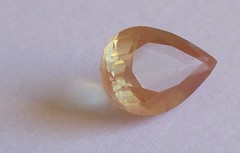
Interesting stone from Mexico, most likely, that underwent copper diffusion that didn't work so well. Teófilo Otoni, MG. Photo by Tenney Naumer, copyright 2009.
Jewelers Ethics Association Industry News , Vol. 2, No. 4 (April 16, 2010).
Why I Am Not Going To The GIA'S Feldspar Conference
by David Federman, JEA Contributing Editor
How I would like to blame my decision not to attend the GIA's feldspar conference this weekend on financial hardship.
But that would be an excuse--not a reason.
And making excuses would be just one or two degrees shy of lying. I'm too old to lie or rationalize or give doctor's notes.
No, the reason I'm not going to the feldspar conference is that this conference is too little too late--and it will not bring the American jewelry industry any closer to clarity and closure about the scandals that have wracked the most popular feldspar of modern times: Oregon sunstone.
Just look at who are absent from the rostrum--the people who know most about this scandal as well as the people who have been most damaged by it. I'm talking about the whistle blowers like Robert James and Joel Arem; I'm talking about the Oregon sunstone miners who have lost millions of dollars due to frauds involving non-disclosure of treatment. If some of these heroes and victims are silly enough to pay money to sit impotently in the audience, this reporter can only lament their decision to waste their money on a cause whose most profound effect will be more frustration for them.
As far as I'm concerned, the conference owes these brave gemologists and defrauded miners honor and obeisance, but they will receive neither. No, the conference will be too busy debating spurious sources for andesine in Tibet and Mongolia--sources that have been thoroughly repudiated by geologists and mining authorities in China. No mention will be made of the economic and marketing necessities for an ample andesine source in "greater China" because of its not-coincidental status as an official Olympics gemstone. Will conference presenters explore Chinese andesine as possibly an elaborate science fiction?
Don't bet on it. Don't even hope for it.
We all know the facts and fictions about the andesine mess. The stuff used to fleece consumers comes from Mexico--by the ton. There is no other proven source capable of providing the material needed for fraud on the scale that we have seen it. I don't care what lab equipment says. Experts can and have been fooled, especially since they're testing material none or very little of which was bought from the TV networks and Internet sellers who engaged in feldspar fraud. It was selected at random from dealer inventories. So I have serious doubts about the relevance of the scientific testing conducted. If the wrong samples were used, the results don't prove anything. At issue here is where the tons of rip-off material needed for the con came from--not whether or not some mountain side in China may produce a couple kilos of bona fide andesine (something I highly doubt). There is only one gemologist I know of who restricted his testing to "store-bought" andesine: Robert James. Moreover, there is only one gemologist I know of who tested hundreds of samples--most of it bought at his own expense: again, Robert James. Yet James has not been invited to present at the conference. Hell, he should be its keynote speaker.
Consequently, to me, the best we can hope for from the conference is that it will be an exercise in hindsight rather than insight. Actually, I would be glad if it could achieve even that much. True hindsight in this matter would involve a thorough critique of the shabby methods used to investigate this scandal and the continuing lack of preparedness to prevent subsequent gemological frauds of similar magnitude.
The truest hindsight would lead to the following foresight: the jewelry industry is a sitting duck for repeat offenses, some of them by repeat offenders such as the shop-at-home TV networks.
So I'm staying home where I know I won't be missed and I certainly won't be missing the action. I hear the weather here on the East Coast is going to be warm and sunny--a match for that on the West Coast. So maybe some of you might want to fly out to Philadelphia and convene a post-mortem for the andesine tragedy. That post-mortem would involve the creation of a gemological civil defense plan that will show the world that the jewelry industry is finally ready to learn from history rather than to continue ignoring it.
Wednesday, February 10, 2010
FIPP2010 (Feira Internacional das Pedras Preciosas), Teófilo Otoni, Minas Gerais

FIPP2010 (Feira Internacional das Pedras Preciosas), August 24-28, 2010, Teófilo Otoni, Minas Gerais
Sunday, December 13, 2009
Photos of FIPP2009 (Feira Internacional das Pedras Preciosas), Teófilo Otoni, Minas Gerais
Tuesday, October 27, 2009
Baby blue and baby pink iridescent bicolor tourmaline bought in Teófilo Otoni

OK, I admit it! I am a sucker for tourmalines, I really am.
Wednesday, October 21, 2009
"Campbell Bridges 1937–2009: The Bridges' Family Needs Your Help" by Lisa Brooks-Pike, RGA
by Lisa Brooks-Pike, RGA
It was an honor to meet recently with Bruce Bridges, son of Campbell Bridges, in the office of Tom Elliot, owner of the North American Gemological Laboratory (NAGL). Within moments of Bruce’s arrival, it was clear that he had the same great qualities and values as his father, and his passion for family and Tsavorite is extraordinary. Bruce and his family have suffered great adversity and even greater loss yet Bruce’s dedication to his father’s lifetime of work and to Tsavorite drive him forward with amazing strength and focus.
Bruce’s visit to NAGL was driven by this passion and dedication. He was there to honor Campbell, and protect the Scorpion mine and the brilliant vanadium-bearing grossular garnet known as Tsavorite. Bruce brought with him a carry-on bag filled with the Scorpion Tsavorite selected as the cream of the crop by Campbell before his brutal murder.
Like a child seeing the moon for the first time, I was in awe of the material Bruce carefully laid out on the desk before us. It was all beautiful – perfect in deep green color, expertly cut and meticulously polished. I expected as much from material hand-selected by Campbell Bridges; I did not expect to be equally awed by his son. Bruce knew every detail of every stone as if he had nurtured and raised them as children. He could touch one and with that touch he knew the exact carat weight and every tiny detail of that gem. These stones were special.
Bruce shared the largest gem quality Tsavorite to come out of the Scorpion mine – a 20.24-carat wonder. I held my breath as it lay in my hand. "The Scorpion King," I thought. Equally as impressive was the perfectly matched suite of graduated pear-cut stones that made their way to a center pear worthy of royalty: his Queen.
The 44 best stones were selected, all over 3 carats, all breathtaking. These 44 stones were about to receive a special inscription by Tom to identify them as Tsavorite mined under the watchful eye of Campbell Bridges. Watching the first stone being inscribed to honor Campbell and protect what he had created was a very emotional and moving experience, but paled in comparison to Bruce’s story.
Bruce’s own account of this tragic event was both heartbreaking and infuriating. He spoke of that awful day as a son who has suffered irreversible loss, but also as one who refuses to give up and bravely fights on through his sorrow. When we spoke he informed us that the local government had only one man in custody, even though he and his security team had provided them with the full names and photographs of the attackers. As of this writing, no other has been arrested, and the man in custody has been released.
He spoke of the current status of the Scorpion Mine with very real trepidation; while Bruce is currently paying armed guards to protect the mine, no one is there to work it. Mining has ceased, and he does not know when security will be established to enable mining to resume. "We wait to see if the government will reestablish protection for the legal miners," he says.
To say that there has been little action regarding the apprehension of Campbell’s murderers would be a gross understatement. There has been some misinformation regarding the identity of the attackers. While some published reports convey the idea that the attackers were locals, Bruce’s own words in his interview with the BBC say something different. Taken from the interview: "There were several politicians, that for their own greed, funded bandits, gangsters and these criminals, and it's the criminal, it's criminals that we fought with, not farmers. The people that murdered my father were known criminals." In fact, Bruce told me that "the vast majority of attackers were Kenyan Somalis with a couple local gangsters."
Bruce has sought the aid of the British and U.S. embassies, but has been informed by both that without a direct invitation by the Kenyan government, they cannot intervene. Tsavorite U.S.A. has sponsored a petition aimed at creating some forward movement and bringing more attention to this tragedy. As of right now, they need only 22 additional signers to reach their goal of one thousand.
I would like to personally urge anyone who has taken the time to read this article to click on the link, sign the petition, and help to bring to justice the murderers of a man who did so much for so many, without asking anything in return.
UPDATE: the petition has reached its goal of 1,000 signatures -- thanks to everyone!
Please click here and sign the petition: http://www.thepetitionsite.com/130/justice-for-campbell-bridges
Bruce Bridges' interview with BBC: http://news.bbc.co.uk/2/hi/africa/8199627.stm
Update:
From Bruce Bridges: "Three men have been arrested and one man released. None of these men are the masterminds but mid to lower tier in the murder, yet are all involved."Tuesday, October 13, 2009
Kicking myself in the posterior again -- Andalusite becoming very rare in Teófilo Otoni

Does anyone still remember when andalusite was a humble stone, unworthy of great consideration?
Wednesday, October 7, 2009
Faceted Green Amber for Sale in Teófilo Otoni -- Part II

A few months back, I wrote a post about the faceted green amber I had seen in Teófilo Otoni, earlier this year.

Tuesday, September 22, 2009
Good news in earlier today from Teófilo Otoni gem dealers exhibiting at the 2009 Hong Kong Gem Show

Gorgeous, enormous, and problematic green tourmalines in Teófilo Otoni


Let's talk about these two beauties.
Monday, September 21, 2009
On Pink Tourmalines from Araçuaí, Minas Gerais -- To Heat or Not To Heat

Generally speaking, many of these pinks look very light and washed out in daylight, but at night, under incandescent light, they have a wonderful color shift and change to a brilliant cherry color, although the brownish tone doesn't ever seem to be totally eliminated by heating.
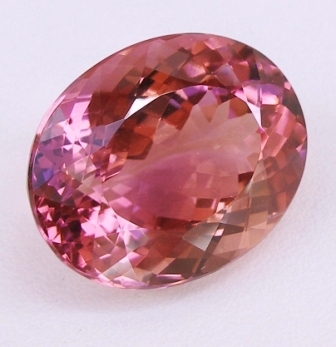
In 2007, I bought an 18-carat oval for my mother -- IF at 30x -- and I had a terrible time trying to photograph it. In fact, I did not succeed. It looked just horrible in daylight, but at night -- wow!
Here is my best shot after several desperate attempts to manipulate the colors using Microsoft's Picture Manager, and it comes nowhere near doing justice to that stone:
On that same trip to Teófilo Otoni, I bought a 15-carat, peachy-pink, trillion-cut tourmaline that has something extra special about it that I have not seen before or since. As best as I can describe it, it was neon. And talk about not being able to photograph the particular beauty of that stone! Goodness! But I sent a message to a client in Rio de Janeiro, and he bought it sight unseen. When he received it, he sent me an e-mail to say that his eyes had fallen of his head when he saw it. It is nice when you have clients like that because if the sale had been based on a photo and not on trust, no one in their right mind would ever have bought that stone.
Friday, September 18, 2009
Imperial topaz, characteristics and description, from the Ouro Preto region of Minas Gerais, available in Teófilo Otoni
 [Photo copyright of Anfilófio Bastos. Please click on the photo at left to see the full screen image in all its glory! Or, click on this text to go to a collection of photos of stunning examples of the finest imperial topaz from the region of Ouro Preto, Minas Gerais!]
Recently, on one of the gemology forums, there was a discussion of imperial topaz. I was pretty surprised by the confusion as to what exactly is an imperial topaz.
For one thing, no one mentioned that the internal structure of real imperial topaz is quite different from common topaz. I don't have the technical vocabulary to describe it, but I can tell you what it does.
First, imperial topaz comes only from Minas Gerais in the region near the city of Ouro Preto. Minas Gerais is a very large state, comprising an area about 50% larger than the state of California, just to give you an idea.
The crystals are usually quite small in comparison to common topaz.
Unlike common topaz, their internal structure contains many tiny fractures. Thus, while cutting and polishing an imperial topaz, great care must be taken or it will break. And, sometimes these fractures are large enough to permit the polishing material to enter. Very fine visible fractures are normal in imperial topaz. Such fine fractures visible only at 10x normally do not affect the value of the stone greatly, although of course a really clear stone is more valuable, much like a clear rubilite tourmaline.
As already mentioned above, the crystal's color will intensify when viewed through the c-axis.
But the main difference is something called in Portuguese brilho de fogo, or "brilliance of fire."
Imperial topaz has a special way of reflecting light that causes it to shimmer.
Anyone who has actually seen real imperial topaz of even moderate quality will have seen this shimmer. It is somewhat similar to a schiller effect, but it is much finer and is extremely difficult to photograph, although I have come close even with my little amateur cameras.
Imperial topaz is defined by these special small shimmering crystals with internal fractures, and so far as I know, the only region in the world where they are found is in Minas Gerais.
As to color: imperial topaz comes in colors from a weak pale yellow to a better gold, to slightly orange, to salmon, to sherry and on along this sort of spectrum -- but they are all imperial topazes.
The difference is in the prices that are paid for these colors.
Some are heated to become pinkish. Lavender is a highly desired but rare color.
Nowadays, some are irradiated, but this is usually discernible because the colors have an intensity and tone that are not natural.
Generally, imperial topaz cannot be cut in the same way as common topaz due to the breakage problem. Thus, there are traditional cuts specific for imperial topaz.
I have seen irradiated citrines and low-quality rubilites cut in these imperial topaz cuts and hawked as imperial topaz.
Five years ago or more, common topaz (slightly off white in color) from the Khatlang province of Pakistan was being irradiated, and this process produced a very strong coppery orange shimmer, which unfortunately faded over time. It was noticeable that the shimmer effect was not nearly so fine. Nevertheless, these stones were often quite pretty.
The producers of this irradiated topaz did not bother to have it cut in the traditional cutting styles of real imperial topaz.
Very often, the irradiation produced very easily discernible color zoning -- something I have never seen in real imperial topaz.
The color was usually an orange copper with grey and brown undertones. It was especially easy to see these undertones and the color zoning if one put the stone, table down, on a piece of white paper and looked through the pavilion.
Sizes could go up to 40-50 carats -- an almost unheard of size for real imperial topaz.
But the dead giveaway was the price.
Even the lowliest cut imperial topaz with a washed-out, orange-salmon color (VS) would cost $12-$15 per carat in Teófilo Otoni.
Here is a link to a flickr album with photos of variously colored imperial topazes cut and available at the firm of Duarte & Bastos in Teófilo Otoni (photos by Anfilófio Bastos):
http://www.flickr.com/photos/dbprecious/sets/72157622158501184/detail/

 Posts
Posts


